The Political Philosophy of the New Deal by Hubert H. Humphrey
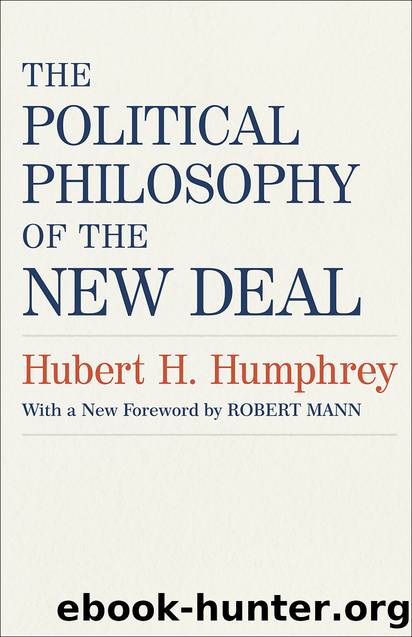
Author:Hubert H. Humphrey [Humphrey, Hubert H.]
Language: eng
Format: epub
Tags: Political Science, General
ISBN: 9780807160350
Google: VRYQBgAAQBAJ
Goodreads: 23529566
Publisher: LSU Press
Published: 1970-01-01T00:00:00+00:00
CHAPTER 4
A More Perfect Union
âTHE CONSTITUTION was intended to endure for the ages and consequently to be adapted to the various crises of human affairs.â Herein lies the proposition that has caused no end of argument concerning the powers and nature of American government. Two interpretations have consistently clouded the political horizon. First, is the Constitution to be considered as a static symbol of an established order? Or, secondly, is it to be looked upon and used as an instrument of power for the common welfare, as that welfare may be determined by the majority of the body politic? The affirmative acceptance of the latter position by the New Deal precipitated one of the most bitter political struggles in American constitutional history.
Long-drawn-out battles as to the meaning, purpose, and powers embodied in the Constitution are more American than the Constitution itself. Just as surely as the major outlines of American constitutional government flow from British sources, judicial and executive controversy over matters of constitutional power find their roots in the famous argument between King James and Lord Coke. British as our political ancestry may be, no one has ever surpassed the originality and poignancy of American controversies as to what the Constitution means and what powers it gives to the national government.
The history of the first century of our national existence records numerous constitutional debates of momentous importance. The issue of âstate rightsâ rang through the halls of Congress until the issue was finally settled on the battlefields of Gettysburg and Atlanta. With the question of secession squelched by the force of arms, the arena of constitutional debate tended to drift in the direction of economic issues. Southern agrarianism had lost its dominant position in the Struggle for economic and political power. Northern industrialism and its copartner, high finance, guided the destinies of the young republic. The accepted policy for government in its relationship to business was bluntly put at âhands off.â It was not until the disappearance of the frontier in the late 1890âs that the heart of constitutional debate reached significant intensity. The explanation for the political apathy of the thirty years following the Civil War seems to be found in the superabundance of free land and the expansive development of industrial plant. Just so long as a safety valve for economic maladjustment existed in the form of new land and expanding work opportunities, the problem of the Constitution and its relationship to government control of business was never examined. This is to say, the Constitution was not allowed to stand in the way of expansion or acquisition of property rights.
The function of the Constitution in the first century of our nationhood was that of securing sufficient allegiance to the union to preserve a national spirit. It was not allowed to interfere in any manner with the conquering of a continent.1 It will further clarify the position of the Constitution in our early years of national life if we remember that its prime objective was to protect property,
Download
This site does not store any files on its server. We only index and link to content provided by other sites. Please contact the content providers to delete copyright contents if any and email us, we'll remove relevant links or contents immediately.
| Anthropology | Archaeology |
| Philosophy | Politics & Government |
| Social Sciences | Sociology |
| Women's Studies |
The remains of the day by Kazuo Ishiguro(9006)
Tools of Titans by Timothy Ferriss(8403)
Giovanni's Room by James Baldwin(7354)
The Black Swan by Nassim Nicholas Taleb(7137)
Inner Engineering: A Yogi's Guide to Joy by Sadhguru(6800)
The Way of Zen by Alan W. Watts(6621)
The Power of Now: A Guide to Spiritual Enlightenment by Eckhart Tolle(5790)
Asking the Right Questions: A Guide to Critical Thinking by M. Neil Browne & Stuart M. Keeley(5779)
The Six Wives Of Henry VIII (WOMEN IN HISTORY) by Fraser Antonia(5519)
Astrophysics for People in a Hurry by Neil DeGrasse Tyson(5196)
Housekeeping by Marilynne Robinson(4455)
12 Rules for Life by Jordan B. Peterson(4312)
Ikigai by Héctor García & Francesc Miralles(4279)
Double Down (Diary of a Wimpy Kid Book 11) by Jeff Kinney(4278)
The Ethical Slut by Janet W. Hardy(4262)
Skin in the Game by Nassim Nicholas Taleb(4257)
The Art of Happiness by The Dalai Lama(4133)
Skin in the Game: Hidden Asymmetries in Daily Life by Nassim Nicholas Taleb(4012)
Walking by Henry David Thoreau(3969)
